Why Niacinamide Is in Two of Our Four Formulas
At Leiba Beauty, every ingredient has to earn its place. Here’s what niacinamide actually does for skin. Five documented benefits, and exactly how each one works in the Leiba routine. Niacinamide passed that filter twice. It’s in the GFF Brightening Toner at 4% and in the Cellular Defense Serum paired with N-Acetyl Glucosamine (NAG).
That’s not an accident. Niacinamide is one of the most extensively studied actives in dermatology, and the clinical evidence supports its use across multiple mechanisms simultaneously. Here’s what the research actually shows — and exactly what it does in each formula.
What Niacinamide Is, Chemically
Niacinamide is the amide form of vitamin B3 — water-soluble, pH-stable across a wide range, and well-tolerated by all skin types including sensitive and reactive. Unlike many actives that require a narrow pH window to function, niacinamide remains bioavailable from pH 3.5 to 7.0, which is why it layers cleanly with acids, peptides, and vitamin C without requiring formulation compromises.
It’s not a single-function ingredient. The clinical data shows five distinct, documented mechanisms.
The Five Documented Mechanisms
1. Barrier Strengthening
Niacinamide promotes the synthesis of ceramides, fatty acids, and cholesterol — the three core lipid classes that form the skin’s protective barrier. Human studies have demonstrated measurable reductions in transepidermal water loss (TEWL) and improved moisture retention with topical niacinamide use.¹
This is the mechanism we use in the Cellular Defense Serum — niacinamide working at the barrier level while Laminaria Saccharina marine polysaccharides and Panthenol address hydration from the surface and structural directions simultaneously.¹
2. Melanin Pathway Inhibition
Niacinamide inhibits the transfer of melanosomes from melanocytes to keratinocytes — the specific step that deposits pigment in the upper skin layers. This is a post-synthesis mechanism, distinct from tyrosinase inhibition. It visibly reduces hyperpigmentation and post-inflammatory marks without the irritation risk of stronger bleaching agents.⁴
In the toner, niacinamide works alongside Galactomyces Ferment Filtrate and Bearberry Extract (arbutin) — three independent brightening pathways at a single step. Niacinamide blocks melanosome transfer while bearberry-derived arbutin inhibits tyrosinase further upstream, so pigment is addressed at two different points in the same pathway.²
3. Sebum Regulation
By moderating sebaceous gland activity, niacinamide reduces pore size and surface shine without over-drying.3 This mechanism is particularly relevant in the toner, where niacinamide at pH 4.3 is fully bioavailable from the first application.
4. Anti-Inflammatory Activity
Niacinamide down-regulates pro-inflammatory mediators including interleukin-8 and TNF-α, calming flare-ups associated with acne, rosacea, and general barrier sensitivity.4 This makes it appropriate for daily use at both AM and PM steps.
5. NAD⁺ Pathway Support
Niacinamide is a precursor to NAD⁺ — a coenzyme essential for cellular energy production and DNA repair. In the Cellular Defense Serum, this mechanism works alongside N-Acetyl Glucosamine (NAG), which inhibits melanin production at the synthesis stage. The niacinamide + NAG pairing is clinically validated: a British Journal of Dermatology RCT (n=202) showed significant hyperpigmentation reduction from the combination (PubMed ID: 19845667).
A note on collagen: niacinamide supports ceramide synthesis and barrier function, which indirectly supports skin structure. Claims about direct collagen synthesis from topical niacinamide are not as robustly supported as the five mechanisms above — we don’t make that claim.
Clinical Validation
Niacinamide is among the most studied actives in cosmetic dermatology. The following studies are directly relevant to the mechanisms described above:
- Bissett et al., 2005 (Dermatologic Surgery) — A 12-week double-blind trial found that 5% niacinamide improved elasticity, pigmentation, fine lines, and wrinkles in aging facial skin.¹
- Bissett et al., 2004 (International Journal of Cosmetic Science) — Demonstrated significant reductions in yellowing, blotchiness, and uneven tone with topical niacinamide.³
- Shapiro & Saliou, 2001 (Nutrition) — Identified vitamin B3 as critical for epidermal function and photoprotection.⁵
- Madaan et al., 2021 (Recent Advances in Anti-Infective Drug Discovery) — Reviewed niacinamide’s cosmeceutical properties including antioxidant, anti-inflammatory, and barrier-strengthening activity.⁴
- Chen et al., 2015 (New England Journal of Medicine) — Showed that oral nicotinamide supplementation reduced rates of non-melanoma skin cancer. This is an oral study — we reference it for the NAD⁺/cellular protection mechanism only. We do not apply its findings to topical claims.²
How Niacinamide Is Used in Leiba Products
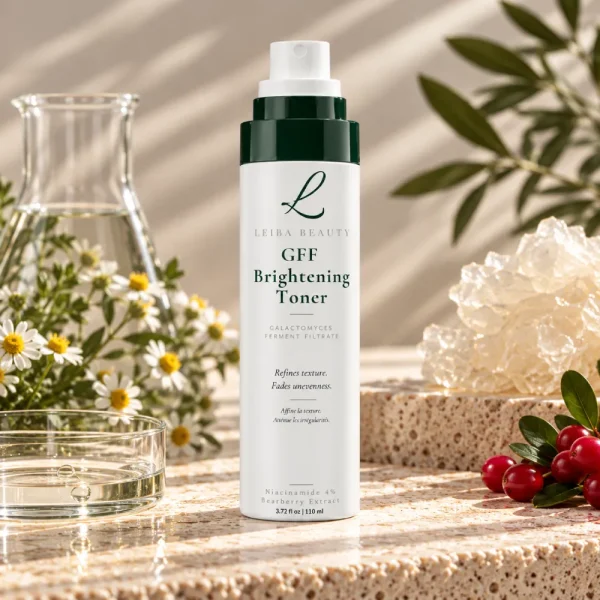
GFF Brightening Toner — Niacinamide at 4%
The toner contains niacinamide at 4% clinical strength, formulated at pH 4.3 — optimized for full bioavailability. Hero ingredients: Galactomyces Ferment Filtrate (GFF) + Niacinamide 4% + Bearberry Extract.
What the toner does:
- Inhibits melanosome transfer (niacinamide) while simultaneously inhibiting tyrosinase (bearberry/arbutin)
- Provides the GFF ferment base — same ingredient class as SK-II’s $185 essence, used here as the formula base, not a trace addition
- Primes skin at pH 4.3 so the serum’s actives that follow absorb efficiently
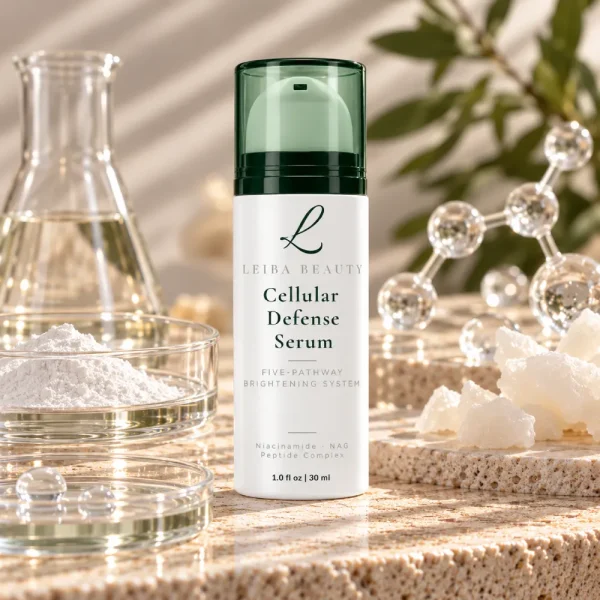
Cellular Defense Serum — Niacinamide + NAG Complex
The serum uses niacinamide paired with N-Acetyl Glucosamine (NAG) — a clinically validated two-ingredient brightening complex. Niacinamide blocks melanosome transfer. NAG inhibits melanin synthesis. Different steps in the same pathway, working simultaneously.
Full confirmed INCI: Water, Propanediol, Niacinamide, Glycerin, Gluconolactone, N-Acetyl Glucosamine, Ammonium, Acryloyldimethyltaurate/VP Copolymer, Laminaria Saccharina Extract, Panthenol, Sodium Benzoate, Sodium Phytate, Butylene Glycol, Carbomer, Coco-Glucoside, Palmitoyl Tetrapeptide7, Palmitoyl Tripeptide-1
Confirmed free of: Fragrance · Dye · Essential oils
Routine position: Step 3 — after the toner, before the moisturizer. pH 5.0–5.5. The toner sits a step earlier at pH 4.3; the two aren’t matched, and they don’t need to be — the toner’s lower pH primes the skin so the serum’s actives absorb efficiently.
Compatibility With Other Actives
Niacinamide’s pH stability makes it one of the easier actives to layer. Confirmed compatible combinations in the Leiba routine:
- With Gluconolactone (PHA) — in the Cellular Defense Serum. PHA exfoliates gently while niacinamide supports barrier recovery simultaneously. No irritation conflict.
- With the peptide complex — in the Cellular Defense Serum. No interaction. Both work at different depths and via different mechanisms.
- With Snow Mushroom polysaccharides — in the moisturizer. Niacinamide addresses pigment and barrier; snow mushroom addresses sustained hydration. Complementary, not competing.
- With retinol — niacinamide is widely documented to reduce retinol-associated irritation. If you use retinol from another brand, applying the Cellular Defense Serum first supports tolerance.
How to Use Niacinamide in the Leiba Routine
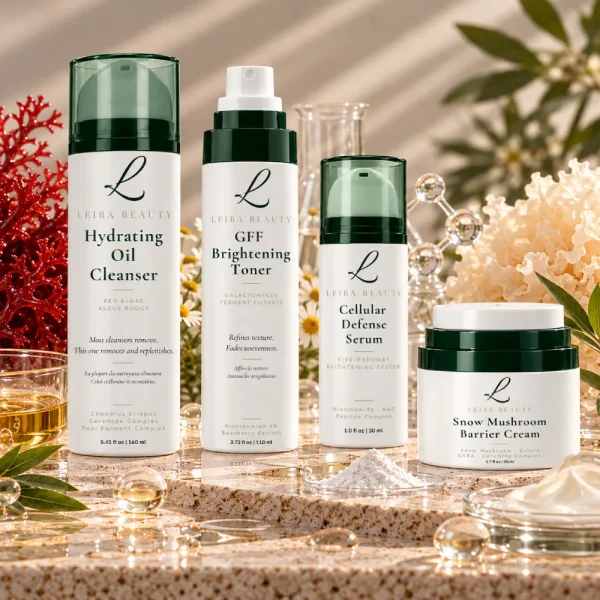
The Leiba routine is a four-step system. Niacinamide appears at Steps 2 and 3:
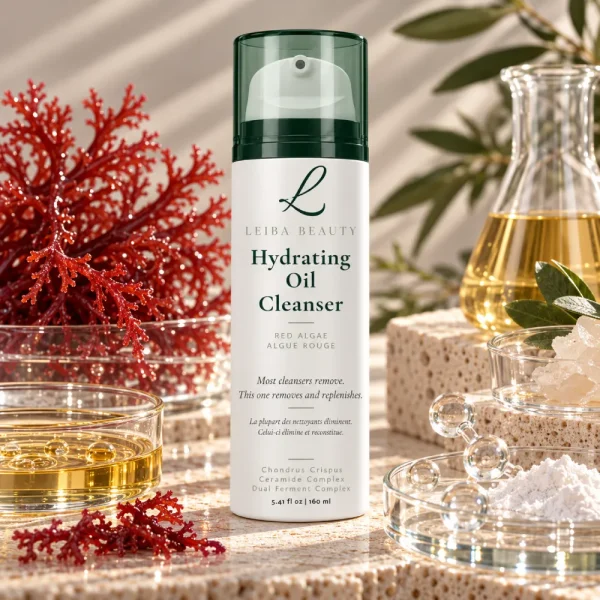
- Remove → Hydrating Oil Cleanser – Red Algae
- Refine → GFF Brightening Toner (niacinamide 4% + GFF + bearberry)
- Protect → Cellular Defense Serum (niacinamide + NAG + Peptide Complex + PHA + Laminaria Saccharina)
- Restore → Snow Mushroom Barrier Cream
Use morning and evening. Always follow with SPF 30 or higher in the morning.
The toner and serum are formulated to work in sequence — the toner’s lower pH primes the skin so the serum’s actives absorb efficiently in the step that follows.
The Bottom Line
Niacinamide is in two Leiba formulas because the evidence supports it at the concentration, pH, and mechanism level in both. It’s not in the formulas because it’s popular. It’s in the formulas because the clinical data is specific, the mechanisms are named, and it does a documented job at each step in the routine.
Five mechanisms. Two formulas. One ingredient that earned its place twice.
With Love,
Sarah Leiba, BSN, RN
Founder, Leiba Beauty
Niacinamide Questions Answered
What is niacinamide, and how does it benefit the skin?
Niacinamide is the amide form of vitamin B3. It works across five documented mechanisms: barrier ceramide synthesis, melanosome transfer inhibition, sebum regulation, anti-inflammatory activity, and NAD⁺ pathway support. It’s one of the few actives with clinical evidence at all five simultaneously.
Is niacinamide safe for sensitive skin?
Yes. Niacinamide is among the best-tolerated actives in dermatology — pH-stable, non-irritating, and effective at concentrations from 2% to 10%. Both Leiba formulas containing niacinamide are fragrance-free, dye-free, and free of essential oils — the most common sensitizers in skincare.
Can I use niacinamide with other active ingredients?
Yes. Niacinamide is compatible with PHAs, peptides, polysaccharides, and retinol. On the vitamin C question: the niacin byproduct concern is largely irrelevant at cosmetic concentrations and normal storage temperatures. Leiba’s current four-product lineup has no vitamin C product — when it launches, compatibility will be addressed in the formula directly.
How long does it take to see results?
For texture and absorption improvement: within the first week. For visible brightening via melanosome inhibition: 2–4 weeks of consistent use. For barrier-level changes measurable by TEWL: 4+ weeks. The toner and serum are designed to be used daily at both steps — results compound over time.
What percentage of niacinamide is best?
Clinical studies show efficacy from 2% upward. The Leiba toner uses 4% — enough for measurable brightening and sebum regulation without the irritation that can occasionally occur above 5% in sensitive individuals. Higher is not always better; 4% at the correct pH and in a formula designed for bioavailability outperforms 10% in a poorly buffered base.
Scientific References
Tanno O, Ota Y, Kitamura N, Katsube T, Inoue S. Nicotinamide increases biosynthesis of ceramides as well as other stratum corneum lipids to improve the epidermal permeability barrier. Br J Dermatol. 2000;143(3):524–531. PMID: 10971324.
Hakozaki T, Minwalla L, Zhuang J, et al. The effect of niacinamide on reducing cutaneous pigmentation and suppression of melanosome transfer. Br J Dermatol. 2002;147(1):20–31. PMID: 12100180.
Draelos ZD, Matsubara A, Smiles K. The effect of 2% niacinamide on facial sebum production. J Cosmet Laser Ther. 2006;8(2):96–101. PMID: 16766489.
Grange PA, Raingeaud J, Calvez V, Dupin N. Nicotinamide inhibits Propionibacterium acnes-induced IL-8 production in keratinocytes through the NF-κB and MAPK pathways. J Dermatol Sci. 2009;56(2):106–112. doi:10.1016/j.jdermsci.2009.08.001.
Chen AC, Martin AJ, Choy B, et al. A phase 3 randomized trial of nicotinamide for skin-cancer chemoprevention. N Engl J Med. 2015;373(17):1618–1626. PMID: 26488693. (Oral study — referenced for the NAD⁺/cellular mechanism only; not applied to topical claims.)
Kimball AB, Kaczvinsky JR, Li J, et al. Reduction in the appearance of facial hyperpigmentation after use of moisturizers with a combination of topical niacinamide and N-acetyl glucosamine: a randomized, double-blind, vehicle-controlled trial. Br J Dermatol. 2010;162(2):435–441. PMID: 19845667.
Bissett DL, Oblong JE, Berge CA. Niacinamide: a B vitamin that improves aging facial skin appearance. Dermatol Surg. 2005;31(7 Pt 2):860–865. PMID: 16029679.
Bissett DL, Miyamoto K, Sun P, Li J, Berge CA. Topical niacinamide reduces yellowing, wrinkling, red blotchiness, and hyperpigmented spots in aging facial skin. Int J Cosmet Sci. 2004;26(5):231–238.