Introduction
At Leiba Beauty, we don’t chase perfection. We support function.
When we talk about skin texture, we mean how skin looks and feels: smooth or bumpy, soft or rough, radiant or dull. Texture isn’t just cosmetic. It’s a direct reflection of how well your barrier is working — how efficiently your skin is turning over, how intact your lipid matrix is, and whether low-grade inflammation is disrupting the surface underneath.
This is our attempt to explain the biology honestly. Why texture changes. What it signals. And how our formulations support the processes that create genuinely smooth skin — not surface-level smoothness that disappears when the product wears off.
What Is Skin Texture, Really?
Texture describes the surface uniformity of skin — how even it appears and how refined it feels under your fingertips.
Healthy texture tends to be soft and smooth, evenly hydrated, and balanced in oil-to-water ratio. When texture becomes uneven, skin can feel dry or flaky, bumpy or congested, rough to the touch, or thin and crepey in ways that weren’t there before.
These aren’t flaws. They’re signals. They reveal what’s happening one or two layers beneath the surface:
- How well your barrier is retaining water
- Whether cell turnover has slowed
- How well sebum is being regulated
- Whether your collagen and elastin support structure is intact
- Whether low-grade inflammation is interfering with normal renewal
Understanding which of these is driving the texture concern changes everything about how you treat it.
What Actually Causes Texture Changes?
What’s happening on the inside
As skin ages, collagen and ceramide synthesis naturally slows. Cell turnover — which runs at roughly 28 days in younger skin — extends to 40 days or longer by the time we’re in our 40s. Hormonal shifts change sebum production. These aren’t problems to be fixed so much as biological realities to be supported.
What’s happening from the outside
UV exposure, pollution, and glycation damage accelerate the process. Glycation — the binding of sugars to collagen and elastin — stiffens the protein structures that give skin its bounce and evenness. Harsh surfactants and alkaline cleansers strip the lipid matrix faster than it can replenish. Over-exfoliation removes the barrier it’s supposed to be refining. Chronic low-grade inflammation, often triggered by the wrong products or microbiome imbalance, keeps the skin in a constant state of recovery rather than renewal.
Most texture problems involve some combination of all of these — which is why single-ingredient solutions rarely solve the whole picture.
Common Texture Concerns and What Drives Them
| Flaky Patches | Dehydration, lipid loss, or over-exfoliation removing the barrier |
| Bumps / Congestion | Retained dead cells combined with excess sebum blocking pores |
| Dullness | A slowed renewal cycle leaving dead cells on the surface |
| Rough patches | Uneven corneocyte buildup from delayed turnover |
| KFine lines / crepiness | Declining collagen and reduced natural moisturizing factors |
The pattern you’ll notice: almost every texture concern involves barrier impairment, delayed turnover, or inflammation — usually all three at once.
The Biology Behind Smooth Skin
Healthy skin renews itself continuously through a process called desquamation — the natural shedding of corneocytes (dead surface cells) as new ones rise to replace them. This process depends on enzymatic activity and a functional lipid matrix within the outermost skin layer, the stratum corneum.
When turnover slows or the barrier weakens, the process breaks down:
- Dead cells accumulate unevenly, creating rough texture
- Water escapes more easily (increased transepidermal water loss, or TEWL)
- The surface becomes dull, congested, or reactive
At the microscopic level, this involves corneocyte retention leading to a thickened, uneven surface — what we recognize as congestion or rough texture. Reduced natural moisturizing factors (NMFs) cause dehydration and loss of elasticity. And diminished ceramide levels in the stratum corneum, which has been documented in both aging and compromised skin, remove the lipid mortar that holds the structure together.
This is why barrier-first formulation strategies matter. You can exfoliate the surface all you want, but if the barrier isn’t intact underneath, you’re working against the biology.
What the Science Says About Improving Texture
What Not to Do
The most common texture mistakes aren’t about using the wrong products. They’re about disrupting the biology in ways that look productive but set the skin back.
Physical scrubs create micro-tears in the surface layer that trigger low-grade inflammation — the opposite of what texture-smoothing requires. Layering multiple exfoliants in one routine (AHA plus BHA plus retinol plus vitamin C) strips the barrier faster than it regenerates. Alkaline soaps and high-foam cleansers raise the skin’s pH above its natural 4.5–5.5 range, impairing the enzyme activity that drives healthy desquamation.
Genuine texture improvement is slow. It’s measured in weeks, not days. The biology works at the speed of cell turnover — and forcing it faster usually means setting it back.
How the Leiba Routine Supports Texture
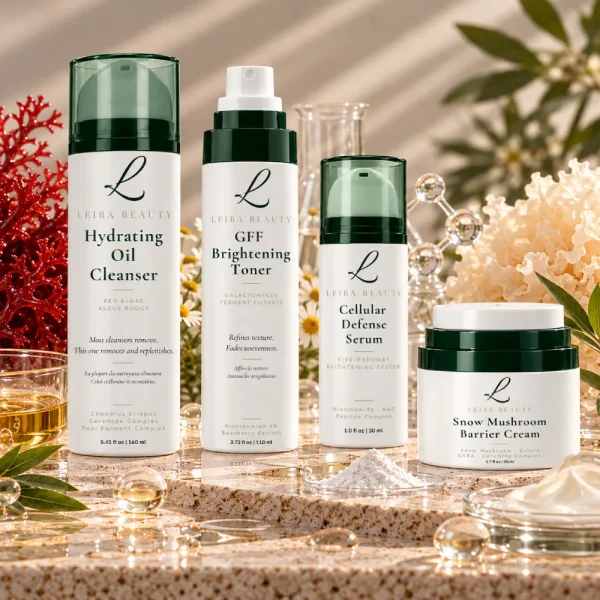
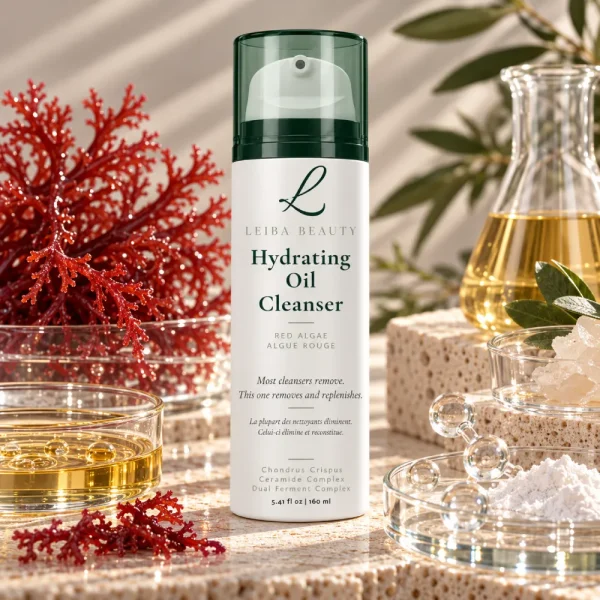
The cleanse sets up everything that follows. This step dissolves sunscreen and makeup through lipophilic action while leaving behind a Ceramide Complex — ceramides NP, AP, and EOP with phytosphingosine and cholesterol — to help offset the barrier lipids that aggressive cleansing can strip.
Chondrus Crispus (Irish Moss) polysaccharides form a conditioning film during rinsing, while the antioxidant system — astaxanthin, tocopherol from sunflower, and rosemary leaf extract — helps neutralize free radicals generated during UV and pollution exposure before they carry into the rest of the routine.
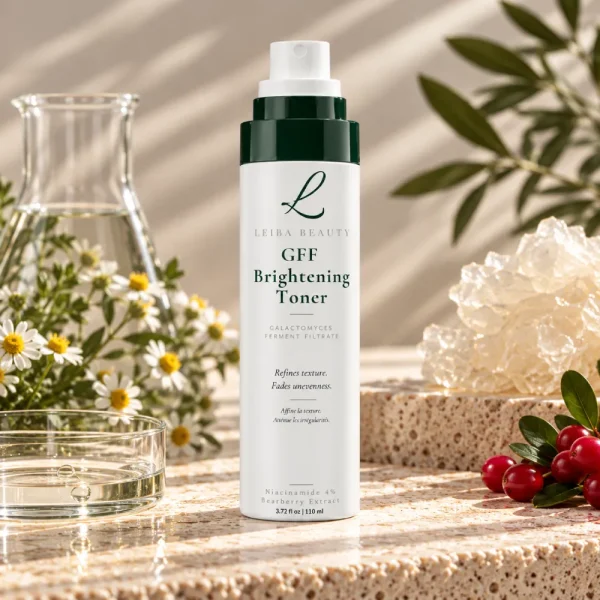
This toner is formulated at pH 4.3 with galactomyces ferment filtrate as the base — the same ingredient class behind SK-II’s Facial Treatment Essence. Niacinamide at 4% begins supporting ceramide synthesis while helping reduce melanosome transfer early in the routine.
Bearberry extract (Arctostaphylos Uva-Ursi) adds a second brightening mechanism by helping inhibit tyrosinase upstream. The toner’s low pH also helps prime the skin surface so the serum’s actives that follow absorb efficiently.
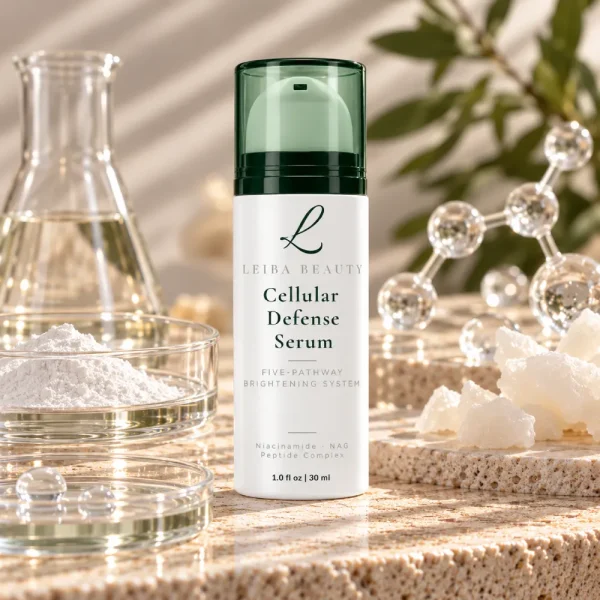
Gluconolactone PHA clears the outer surface layer without the irritation profile of glycolic or lactic acid. It was chosen specifically because its larger molecular size keeps it working primarily in the stratum corneum.
Niacinamide + N-Acetyl Glucosamine interrupt the melanin pathway from two different angles. Peptide Complex — Palmitoyl Tripeptide-1 + Palmitoyl Tetrapeptide-7 — supports collagen signaling, while Laminaria Saccharina helps reduce transepidermal water loss through a surface hydration mechanism that complements, rather than duplicates, panthenol’s barrier support.
This is the final seal. Ectoin helps shield skin cells from environmental and osmotic stress at the membrane level. Snow mushroom (Tremella fuciformis) polysaccharides bind water comparably to hyaluronic acid and form a flexible hydration film that holds up in dry environments. Lab studies indicate they also help maintain moisture and collagen under UV-induced oxidative stress.
A second Ceramide Complex — ceramides NP, AP, and EOP with phytosphingosine and cholesterol — helps lock the barrier in at the final step. GABA supports hydration at the cellular level by upregulating Aquaporin-3, a channel protein involved in water movement through skin cells, while also supporting filaggrin expression, a critical barrier protein.
Texture as a Signal of Skin Health
Texture isn’t a flaw. It’s feedback.
A rough patch usually means dehydration or barrier disruption. Bumps point to congestion — dead cells and sebum that aren’t clearing because turnover has slowed. Dullness reflects fatigue in the renewal process, not a permanent change in the skin you have.
When you respond to those signals with the right biology — consistent hydration, gentle exfoliation, intact barrier lipids, targeted active support — skin restores its own balance. That’s the process we formulate for: not altered texture, but alive skin doing what it’s designed to do.
With Love,
Sarah Leiba, BSN, RN
Founder, Leiba Beauty
Skin Texture Questions Answered
What causes rough or uneven texture?
Rough texture is most commonly caused by slowed cell turnover (dead cells accumulating on the surface), dehydration from a compromised barrier, or a combination of both. UV damage, harsh cleansers, and inflammation accelerate the process.
How can I smooth my skin texture safely?
Chemical exfoliants — particularly PHAs and AHAs at appropriate pH levels — are the safest route for most skin types. PHAs are especially well-tolerated because their larger molecular size limits how deep they penetrate. Pairing exfoliation with barrier support (ceramides, niacinamide, humectants) prevents the stripping that turns texture refinement into texture damage.
Does exfoliation help texture?
Yes — but only when it’s matched to your barrier’s capacity to recover. Exfoliating faster than your barrier can regenerate creates reactive roughness that looks like the problem you’re trying to solve.
Can niacinamide improve texture?
Yes, through multiple mechanisms. It enhances ceramide synthesis in the stratum corneum, increases barrier protein production, reduces TEWL, and has anti-inflammatory activity that calms the microinflammation driving reactive texture changes.
Why does my skin stay bumpy despite cleansing and moisturizing?
Bumps that persist despite cleansing usually indicate that the cleanser isn’t actually clearing oil-based debris — sunscreen, sebum, makeup — from the pore. Oil cleansing, which dissolves oil-based buildup through the same lipophilic chemistry, tends to be more effective than foam or gel cleansers for congestion-type texture concerns.
Is rough skin permanent?
Rarely. Most texture concerns reflect processes that are disrupted — turnover, hydration, barrier integrity — rather than irreversible structural changes. The biology can be supported toward smoother skin at almost any age, though it requires consistency over weeks, not days.
Scientific References
Bissett DL, Miyamoto K, Sun P, Li J, Berge CA. Topical niacinamide reduces yellowing, wrinkling, red blotchiness, and hyperpigmented spots in aging facial skin. Int J Cosmet Sci. 2004;26(5):231–238.
Tanno O, Ota Y, Kitamura N, Katsube T, Inoue S. Nicotinamide increases biosynthesis of ceramides as well as other stratum corneum lipids to improve the epidermal permeability barrier. Br J Dermatol. 2000;143(3):524–531. PMID: 10971324. · Hakozaki T, Minwalla L, Zhuang J, et al. The effect of niacinamide on reducing cutaneous pigmentation and suppression of melanosome transfer. Br J Dermatol. 2002;147(1):20–31. PMID: 12100180.
Kono T, et al. Clinical significance of the water retention and barrier function-improving capabilities of ceramide-containing formulations: a qualitative review (12 studies). J Dermatol. 2021. PMID: 34596254. · Draelos ZD. The effect of ceramide-containing skin care products on eczema resolution duration. Cutis. 2008;81(1):87–91. PMID: 18306855.
Woźniak B, Chudzińska J, Szczyglewska P, Nowak I, Feliczak-Guzik A. Optimization of the composition of a cosmetic formulation containing Tremella fuciformis extract (fungi). Cosmetics. 2023;10(3):82. doi:10.3390/cosmetics10030082. · Fu H, et al. Tremella fuciformis polysaccharide, UVA photodamage (in vitro). J Cosmet Dermatol. 2021;20(12):4052–4059. PMID: 36757441. · Ma X, et al. Int J Immunopathol Pharmacol. 2021;35 (PMC8172338, review).
GABA, filaggrin and aquaporin-3 upregulation in keratinocytes. Cosmetics. 2024;11(1):19. doi:10.3390/cosmetics11010019.
Ectoin, TEWL reduction and barrier support. PMC12158106; Dermatology and Therapy systematic review, PMC8850511.
Chen HJ, Lee PY, Chen CY, et al. Moisture retention of glycerin solutions with various concentrations: a comparative study. Sci Rep. 2022;12:10232. doi:10.1038/s41598-022-13452-2.
Lintner K. Peptides, amino acids and proteins in skin care. Cosmetics & Toiletries. 2007;122(10):26.
Chen et al. The optimal cleansing method for the removal of sunscreen: water, cleanser or cleansing oil? J Cosmet Dermatol. 2020;19(3). doi:10.1111/jocd.12995. · López-Hortas L, et al. Physicochemical evaluation of personal care products developed with Chondrus crispus fractions. Marine Drugs. 2022;20(11):695. PMC9692426.