Snow Mushroom (Tremella fuciformis): The Hydration Science
Snow mushroom has been used in East Asian skincare and medicine for centuries, long before anyone could explain why it worked. Now we can. Its polysaccharides hold water in a way that’s remarkably close to hyaluronic acid, but with a longer-lasting film and an antioxidant side that HA doesn’t have. Here’s what the research actually shows, and where it’s still early.
The short version
- Snow mushroom polysaccharides hydrate comparably to hyaluronic acid — and hold that hydration longer in dry air.
- They form a flexible, breathable film that slows water loss from the skin’s surface.
- In lab studies, they also protect skin cells from oxidative and UV stress through named antioxidant pathways.
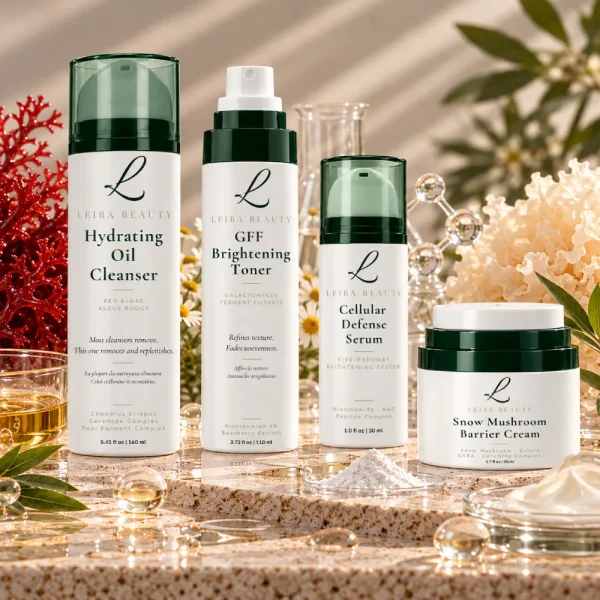
- We use it at 2% in the Snow Mushroom Barrier Cream, alongside our Ceramide Complex, ectoin, and GABA.
- The hydration data is solid and formulation-tested; the antioxidant work is promising but still early. We’ll tell you which is which.
What is snow mushroom?
Snow mushroom, or Tremella fuciformis, is a translucent, jelly-like edible fungus native to East Asia. In skincare, the active part is its polysaccharide — a large, branching sugar molecule that binds and holds water. That structure is what lets snow mushroom hydrate the skin’s surface and lay down a light, flexible film, the same broad way a humectant like hyaluronic acid does.
What makes it interesting isn’t just that it holds water. It’s that the same molecule also carries antioxidant activity — so in one ingredient you get surface hydration and a measure of cellular defense. That’s an unusual combination for a humectant, and it’s the reason snow mushroom earned a place in our barrier cream instead of simply reaching for more HA.
Snow mushroom vs. hyaluronic acid
Hyaluronic acid is the humectant most people know, so it’s the fair comparison. Both pull water into the upper layers of skin. The practical difference is staying power — and what each one does beyond hydration.
| Snow Mushroom | Hyaluronic Acid | |
|---|---|---|
| Hydration | Binds water comparably to HA | Strong water-binding |
| Staying power | Holds hydration longer in dry conditions | Can lose water to dry air |
| Surface film | Forms a flexible, breathable film | Minimal film |
| Antioxidant activity | Yes, in lab studies | No |
| Molecule | Large branching polysaccharide | Varies by molecular weight |
The honest takeaway: snow mushroom hydrates about as well as HA, holds it longer, and brings antioxidant activity HA doesn’t. We don’t claim it “beats” HA or holds “500 times its weight in water” — those figures aren’t peer-reviewed. The real data is good enough without them.
What the science shows
Tap each to see the study behind it. We’ve kept the framing honest — where the evidence is from cell or animal work rather than human trials, we say so.
How we use it: the Snow Mushroom Barrier Cream
2% snow mushroom — plus what it can't do alone
In the Snow Mushroom Barrier Cream, snow mushroom sits at 2% — enough to do the hydration work, not a token dusting for the label. It's paired with ingredients that cover the rest:
- Ceramide Complex (ceramides NP, AP and EOP with phytosphingosine and cholesterol) rebuilds the barrier's own lipids.
- Ectoin shields skin cells from environmental and osmotic stress.
- GABA supports hydration at the cellular level by upregulating aquaporin-3 and filaggrin.
- Single-weight sodium hyaluronate adds a second humectant that works alongside snow mushroom rather than competing with it.
Snow mushroom, answered
Is snow mushroom better than hyaluronic acid?
Does snow mushroom have anti-aging benefits?
Is it safe for sensitive or acne-prone skin?
Can I use it with retinol, vitamin C, or acids?
How is snow mushroom different from other hydrators?
Scientific References
Shen T, Duan C, Chen B, et al. Tremella fuciformis polysaccharide suppresses hydrogen peroxide-triggered injury of human skin fibroblasts via upregulation of SIRT1. Mol Med Rep. 2017;16(2):1340–1346. doi:10.3892/mmr.2017.6754. PMID: 28627707.
Lin M, et al. Tremella fuciformis polysaccharides alleviates UV-provoked skin cell damage via regulation of thioredoxin interacting protein and thioredoxin reductase 2. Photochem Photobiol Sci. 2023. doi:10.1007/s43630-023-00450-0. PMID: 37458972.
Woźniak, B., Chudzińska, J., Szczyglewska, P., Nowak, I., & Feliczak-Guzik, A. (2023). Optimization of the Composition of a Cosmetic Formulation Containing Tremella fuciformis Extract (Fungi). Cosmetics, 10(3), 82.
Mineroff J, Jagdeo J. The potential cutaneous benefits of Tremella fuciformis. Arch Dermatol Res. 2023;315(7):1883–1886. doi:10.1007/s00403-023-02550-4. PMID: 36757441.